Introduction
One of the most important monographs on the history of early Shīʿīsm in western academia is the 1993 work by Hossein Modarressi, “Crisis and Consolidation in the Formative Period of Shīʿīte Islam”. Written by an erudite scholar who combines both traditional ḥawza learning and secular academic training, the book has been extremely influential in academic circles, cited by nearly all subsequent scholars writing about this crucial period.
The book has also been read by persons of faith, especially inquisitive youth in the English-speaking Twelver community, who are attracted by the scholarly treatment found therein, a welcome change from the non-critical ‘traditional’ story-telling approach normally encountered on pulpits.
Claims by apologists notwithstanding, the book does pose significant challenges to some points in the ‘orthodox’ narrative and has been known to engender doubts in some readers. Speaking from personal experience, there were a few unsettling questions the book raised which I could not resolve when I first read the book in my early youth.
This can be attributed to the nature of the book, wherein a uniform narrative is told authoritatively, with each statement seemingly supported by copious references in the footnotes. Any reader who suffers from a language barrier when dealing with the admittedly difficult classical Arabic of the original sources, and lacks sufficient ‘immersion’ into the Twelver corpus to be able to navigate through it while making sense of the ‘context’ and ‘background’, is at the mercy of the author, with no option but to accept said narrative wholly, abandon it wholly, or remain in confused limbo.
I recently decided to re-read the book line-by-line while going through all the footnotes, one after the other, to evaluate whether the narrative told is upheld by the original sources referenced or not. A review of the whole book in this manner will take up too much space and will turn into a book by itself; instead, I document my results over a small section of the book (from pp. 65-70) dealing with the Imamate of al-ʿAskarī. I believe, however, that the methodological flaws highlighted here can be generalized to the book as a whole. I hope that this exercise will act as a cautionary tale for those who are quick to wholly accept a work – any work – as gospel, without possessing the capability to judge its merits for themselves.
Disclaimer: There are a number of works critiquing Modarressi’s book in the Persian language, but I have not consulted these because I do not read Persian. Consequently, the critique here is my own unless otherwise indicated by reference to others who are explicitly named.
- Were the Doubts about al-ʿAskarī Unprecedented?
A major narrative thrust in Modarressi’s book is that of ‘the decline of the Imamate’, wherein the latter Imams do not live up to the standard of their earlier illustrious forebears, resulting in the proliferation of doubt among the masses of the Shia about their legitimacy and an increased challenge to their authority. This reaches its peak with the last public Imam, who was al-Ḥasan al-ʿAskarī, and while Modarressi admits that “the overwhelming majority of the Imamites accepted Ḥasan al-ʿAskarī as the Imam after the death of ʿAlī al-Hādī”, circumstances “seem to have led many to question his authority, which led in turn to an unprecedented lack of faith in and lack of deference toward the new Imam”.
Modarressi proceeds to cite a few examples in order to support this contention.

The narrator of the first report[1] which has the Imam “complaining” and the “visitor from the town of Qum” in the second report,[2] are, in-fact, the same man: Aḥmad b. Isḥāq al-Qummī, an important wakīl (agent of the Imam) and a scholar, in his own right, from the town of Qum.
Much has been made about the ‘disputes’ that usually erupted after the death of an Imam; but, as I have argued in another article,[3] the emergence of multiple claimants was unavoidable and the Imamites were supposed to use certain ‘criteria’ to filter out pretenders and coalesce around the true successor.
In the case of al-ʿAskarī, the fact that there was a faction who had placed great hopes in his elder brother Muḥammad already in the lifetime of their father al-Hādī, followed by Jaʿfar, al-ʿAskarī’s brother, contesting the succession by declaring his Imamate openly, meant that there was a controversy that needed to play out. But, was the extent of this controversy and the doubt it engendered really unprecedented in the history of the Imamate?
The ‘complaint’ of the Imam is actually part of a letter that reads like an ‘appeal’ to ‘doubters’ by reminding them of the agreed upon principle of the permanence of the Imamate. Should the statement therein be considered history proper as opposed to an effective employment of emotive rhetoric (hyperbole) to influence its audience?
Modarressi does not also quote the answer to the question that the Imam posed to this “visitor from the town of Qum”, which is:
O my master, when your letter arrived[4] there was no single man, woman, or child who has reached the age of understanding, except that they subscribed to the truth (i.e. your Imamate)!
The Imam is glad to hear this and responds:
I praise Allah for that, O Aḥmad.
Don’t you know that the earth is never devoid of a ḥujja and I am that ḥujja!
Was this part of the report – which indicates the unanimity of the whole populace of the important town of Qum in accepting al-ʿAskarī’s Imamate – left out because it is not amenable to the narrative being constructed?
This flaw, whereby Modarressi highlights only that part of the report which he has an interest in without giving the full contents of the report which can qualify his point, repeats itself in numerous instances throughout the book.
- Was Al-ʿAskarī’s Chastity in Doubt?

Allegations against what Modarressi somewhat misleadingly calls “the chastity of the Imam” is no small matter!
Modarressi’s sole basis for this is the following description of a splinter group that arose amidst the controversy following al-ʿAskarī’s death as given by the Ismaili polemicist Abū Ḥātim al-Rāzī (d. 322) in his Kitāb al-Zīnā:
The fifth group asserted that al-Ḥasan had died and was not an Imam. We were wrong in considering him one. The (true) Imam was Muḥammad b. ʿAlī, the brother of al-Ḥasan and Jaʿfar, and he had died in the lifetime of his father.
This is because the Imamate of al-Ḥasan was invalidated in their estimation because he died without a successor. As for Jaʿfar, he is not eligible for the Imamate because of what we found in him of evident fisq (sins) committed publicly. We found in al-Ḥasan the same as we found in Jaʿfar except that he (i.e. al-Ḥasan) would conceal it.
So when the Imamate has been invalidated for them both, we realized that the Imam is Muḥammad; as he has lineal descendants, and there was an indication from his father in his favour, and he (i.e. Muḥammad) is the qāʾim and the mahdī. There is no other option (than this) unless we assert the invalidation of the Imamate as a whole![5]
It has become clear to me that Abū Ḥātim’s source for the description of this and other splinter groups was al-Nawbakhtī’s (d. bet. 300-310) Firaq al-Shīʿa.
Consider the table below where the description of the first four groups in both works[6] are given side-by-side with similar statements shaded red.
|
Al-Nawbakhtī in Firaq al-Shīʿa |
Abū Ḥātim in Kitāb al-Zīnā |
|
ففرقة منها قالت أن الحسن بن علي حي لم يمت وإنما غاب وهو القائم ولا يجوز أن يموت ولا ولد له ظاهر لأن الأرض لا تخلو من إمام وقد ثبتت إمامته والرواية قائمة أن للقائم غيبتين فهذه الغيبة احداهما وسيظهر ويعرف ثم يغيب غيبة اخرى وقالوا فيه ببعض مقالة الواقفة على موسى بن جعفر، وإذا قيل لهذه الفرقة ما الفرق بينكم وبين الواقفة قالوا …
|
فرقة قالت ان الحسن حي لم يمت وهو القائم ولا يجوز أن يموت ولا ولد له ظاهرا لأن الارض لا تخلو من امام وقد روينا ان القائم له غيبتان فهذه احدى الغيبتين وسيظهر ويعرف ثــم يغيب غيبة اخرى
|
|
وقالت الفرقة الثانية: أن الحسن بن علي مات وعاش بعد موته وهو القائم المهدي لأنا روينا أن معنى القائم هو أن يقوم من بعد الموت ويقوم ولا ولد له ولو كان له ولد لصح موته ولا رجوع لأن الامامة كانت تثبت لخلفه ولا اوصى إلى احد فلا شك أنه القائم والحسن ابن علي قد مات لا شك في موته ولا ولد له …
|
وقالت الفرقة الثانية ان الحسن مات ولكنه يحيا أو هو حي وهو القائم ولانا رأينا ان معنى القائم هو القيام بعد الموت
|
|
وقالت الفرقة الثالثة: أن الحسن بن علي توفي والامام بعده اخوه جعفر وإليه اوصى الحسن ومنه قبل الامامة وعنه صارت إليه، فلما قيل لهم أن الحسن وجعفرا ما زالا متهاجرين متصارمين متعاديين طول زمانهما وقد وقفتم على صنايع جعفر ومخلفي الحسن وسوء معاشرته له في حياته ولهم من بعد وفاته في اقتسام مواريثه قالوا … |
وقالت الفرقة الثالثة ان الحسن قد مات وأوصى الى جعفر ورجعت الى القول بامامة جعفر
|
|
وقالت الفرقة الرابعة: أن الامام بعد [أبو] الحسن جعفر وأن الامامة صارت إليه من قبل ابيه لا من قبل اخيه محمد ولا من قبل الحسن ولم يكن إماما ولا الحسن أيضا لأن محمدا توفي في حياة ابيه وتوفي الحسن ولا عقب له وأنه كان مدعيا مبطلا والدليل على ذلك … |
وقالت الفرقة الرابعة ان الحسن قد مات والامام جعفر وانا كنـــــــا مخطئين في الائتمام به لانه لم يكن اماما فلما مات ولا خلف له علمنا ان جعفر كان محقا في دعواه وان الحسن كان مبطلا |
The identical ordering of the splinter groups, and the affinity in language means, that these two works are related. The fact that Nawbakhtī provides much more detail for each group means that the borrowing was by Abū Ḥātim, who was briefly summarising the much lengthier description given by Nawbakhtī in his own work. This also makes sense because as an Imamite himself, Nawbakhtī would have possessed superior knowledge about these groups as they concern him personally.
Now let us look at the fifth group as described in the respective works:
| Al-Nawbakhtī in Firaq al-Shīʿa | Abū Ḥātim in Kitāb al-Zīnā |
|
As for the fifth group they reverted to asserting the Imamate of Muḥammad b. ʿAlī who had died in his father’s lifetime. They asserted that al-Ḥasan and Jaʿfar had claimed a status that was not theirs. That their father had not indicated either of them in regards to succession or Imamate. That nothing of the sort was transmitted from him (i.e. their father) concerning that whatsoever. That he did not designate them to any position which necessitates their Imamate. That they were not fitting for that, especially Jaʿfar, for he possesses repugnant qualities which he is well known for. It is not permissible for such qualities to belong to a righteous Imam. As for al-Ḥasan then he had died without leaving behind descendants, so we have realized that Muḥammad was the Imam. The indication of his father in his favour is proven while al-Ḥasan died without leaving behind descendants. It is not permissible for an Imam to die without having a successor. We also saw Jaʿfar, both in the lifetime of al-Ḥasan and even after his death, apparent in fisq, not guarding himself (against it), sinning publicly! … So when it is invalid for the Imamate to belong to someone like Jaʿfar in our estimation, and it is similarly invalid for one who does not have a successor, there is no option left except to cling to the Imamate of their brother Abū Jaʿfar Muḥammad b. ʿAlī … So there is no option but to espouse his (i.e. Muḥammad’s) Imamate, and to consider him the qāʾim, the mahdī, or alternatively to consider the Imamate as a concept to be invalidated, something that is not permissible. |
The fifth group asserted that al-Ḥasan had died and was not an Imam. We were wrong in considering him one. The (true) Imam was Muḥammad b. ʿAlī, the brother of al-Ḥasan and Jaʿfar, and he had died in the lifetime of his father. This is because the Imamate of al-Ḥasan was invalidated in their estimation because he died without a successor. As for Jaʿfar, he is not appropriate for the Imamate because of what we found in him of evident fisq (sins) committed publicly. We found in al-Ḥasan the same as we found in Jaʿfar except that he (i.e. al-Ḥasan) would conceal it. So when the Imamate has been invalidated for them both we realized that the Imam is Muḥammad, for he has lineal descendants, and there was an indication from his father in his favour, and he (i.e. Muḥammad) is the qāʾim and the mahdī. There is no other option (than this) unless we assert the invalidation of the Imamate as a whole!
|
Abū Ḥatim is more or less accurate in summarising Nawbakhtī’s description with one exception: Nawbakhtī’s description contains no allusion whatsoever to the group impugning al-ʿAskarī’s “chastity” in any way!
Nawbakhtī is very clear that the group’s reason for disqualifying Jaʿfar’s Imamate was different from their reason disqualifying al-ʿAskarī’s.
There is no option but to conclude foul-play on the part of Abū Ḥatim! He has added a detail that is not found in his source.[7]
The result is that Abū Ḥatim’s description of the group is not internally consistent. It begins by giving the same reason as Nawbakhtī for the group’s rejection of al-Ḥasan’s Imamate, which is that “he died without a successor”, before going on to state that the splinter group had also “found in al-Ḥasan” the same as what was public knowledge about Jaʿfar. But, if it was so then why did they not abandon al-ʿAskarī in his lifetime?![8] After all, the description is clear that this splinter arose after the death of al-ʿAskarī![9]
It is on such a dubious basis that Modarressi casts aspersions on al-ʿAskarī’s chastity!
- Was al-ʿAskarī Lacking in Knowledge?

Modarressi is doing a disservice to his readers when he refers vaguely to those who questioned al-ʿAskarī’s knowledge as “some of the Imamites of the time” without identifying them. In fact, when we refer to the reference he gives, these Imamites were the followers of al-ʿAskarī’s rival, Jaʿfar, who was openly calling to his own Imamate in the lifetime of his brother, with relations between the two brothers becoming extremely strained.
To quote Abū Ḥatim (the reference Modarressi gives):
Al-Ṭāḥiniyya: They were called the Ṭāḥiniyya being attributed to a leader of theirs who used to go by the name ʿAlī b. so-and-so al-Ṭāḥin. He was a theologian. He is the one who supported Jaʿfar’s cause and inclined the people towards him. He was supported by Fāris b. Ḥātim b. Bāhawayh (sic. Māhawayh) and a sister of Fāris. This group espoused the Imamate of Jaʿfar in the lifetime of al- Ḥasan and said, “We tested al-Ḥasan and did not find him to possess knowledge”. They dubbed those who followed al-Ḥasan and subscribed to his Imamate as the “Ḥimāriyya” [the jackass party] and stated that these had followed al-Ḥasan without any knowledge or cognisance …[10]
As Modarressi himself documents in detail, there was no love lost between the followers of al-Ḥasan and the followers of Jaʿfar, with the vicious name the latter used for the former enough to show the depth of their mutual contempt. The aforementioned Fāris b. Ḥātim was a renegade wakīl who was assassinated per the instruction of al-Hādī himself. As for his sister, she was out for revenge and possessed a palpable hatred of al-Hādī’s widely accepted successor, al-ʿAskarī. She began supporting Jaʿfar’s cause against al-ʿAskarī.
There were allegations and counter allegations being thrown around by the respective groups in an attempt to disqualify the rival’s Imamate. The followers of al-Ḥasan, who were the majority, pointed to Jaʿfar’s public sinning, while the followers of Jaʿfar, very much in the minority, claimed that al-ʿAskarī was lacking in knowledge.
Since both sides are biased, a historian cannot take one side’s allegation at face value but must judge the merit of each allegation with external evidence. Modarressi does this well when he concludes that there must have been some truth to the charge against Jaʿfar since even his defenders did not deny it completely but tried to gloss over it as youthful misdemeanours which he had gotten over.[11]
Something similar would be needed if this charge of al-ʿAskarī’s impoverished knowledge is to stick!
- Was Al-ʿAskarī Criticized for Renting His Collar?
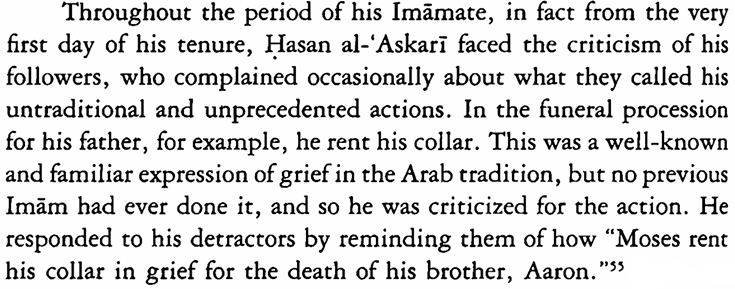
A ‘critical’ approach to the sources as advocated by western academia requires a historian to be sceptical of the highly reverent portrayal of the Imams found in the Twelver corpus which is largely deemed to be pious hagiography, while prioritising as more likely to be historical those ‘embarrassing’ elements that go against this trend, as per the ‘criterion of embarrassment’. For example, a laudatory statement about al-ʿAskarī made by a subservient follower, as quoted in the Twelver corpus, is not very significant; but, al-ʿAskarī being criticized by a follower is more likely to be true because you would not expect the tradition to record this if it were not true, as this would serve to weaken its own ‘orthodoxy’.
Modarressi applies this criterion across his study of al-ʿAskarī, carefully reading through all the relevant material and isolating those elements which are deemed ‘embarrassing’ to form the bed-rock of his portrayal, beginning with al-ʿAskarī’s “unprecedented action” of “renting his collar” for which he was “criticized” on the “very first day of his tenure”.
But what if Modarressi has wholly misunderstood the nature and purpose of these reports which contain certain ‘embarrassing’ elements?
What if the ‘embarrassing element’ is not an inconvenient historical fact that the report is trying to obscure or deal with, but integral to the purpose of the circulation of the report in the first place?
Consider the two reports which have al-ʿAskarī being criticised for renting (tearing) his (garment’s) collar that Modarressi references as translated below:
[I] Aḥmad b. ʿAlī b. Kulthūm al-Sarakhsī. He said: Abū Yaʿqūb Isḥāq b. Muḥammad al-Baṣrī narrated to me. He said: Muḥammad b. al-Ḥasan b. Shammūn and others apart from him narrated to me. He said:
Abū Muḥammad (i.e. al-ʿAskarī) came out in the funeral procession of Abī al-Ḥasan (i.e. al-Hādī) whilst having rent his collar. So Abū ʿAwn al-Abrash, the relative of Najāḥ b. Salama, wrote to him, “Whom among the Imams have you seen, or it has reached you from them, that they rent their garment in an event like this?!”
Abū Muḥammad wrote to him: “O fool! How would you know what this is?! Moses had rent for Aaron”[12]
And:
[II] Aḥmad b. ʿAlī. He said: Isḥāq narrated to me. He said: Ibrāhīm b. al-Khaḍīb al-Anbārī narrated to me. He said:
Abū ʿAwn al-Abrash, the relative of Najāḥ b. Salama, wrote to Abī Muḥammad (i.e. al-ʿAskarī), “The people were repelled by you renting your garment for Abī al-Ḥasan!”
He replied, “O fool! What do you have to do with that?! Moses had rented for Aaron. Among men are those who are born believers, live as believers, and die as believers; among them are those who are born as disbelievers, live as disbelievers, and die as disbelievers; and among them are those who are born believers, live as believers, but do not die except as disbelievers. You will not die except a disbeliever having lost your mind!
[The narrator comments:] So his (i.e. Abū ʿAwn’s) children had to keep him confined away from people, and detained him in his house, sometime before his death, because he lost his mind, was disturbed, and became greatly confused. He began rejecting the Imamate and his true belief became disclosed (to all)[13]
Note that the first report is clearly a truncated version of the more complete second report.
A study of the chains of these two reports demonstrates that they are from the milieu of the ghulāt. Isḥāq b. Muḥammad al-Baṣrī (the common link), who occurs in the chain of both reports, is the infamous head of the Isḥāqiyya which rivalled the Nuṣayriyya in its doctrines.
Najāshī (d. 450) describes Isḥāq as ‘a mine field (source) of takhlīt (incorrect belief)’[14]
Ibn al-Ghaḍāʾirī goes even further:
He was corrupt in madhhab, a liar in narration, a fabricator of ḥadīth, no attention is paid to what he narrates, nor are his ḥadīth utilized[15]
But why were the ghulāt, known for exaggerating the Imams status to the point of divinity, narrating this report?
The answer is obvious. The report culminates with a ‘foolish’ Abū ʿAwn being smacked down by the Imam.
In the first report, the Imam reveals his superior knowledge which everyone was ignorant of. Past Imams might have not done this but a Prophet like Moses had done it for Aaron. Indeed this practise, called kriah in Hebrew, is attested to in the Bible as being done by a number of Patriarchs or Prophetic figures,[16] and is still observed by observant Jews as part of their mourning rituals.
The second report in even more blatant. The fate of the ‘foolish’ Abū ʿAwn is sealed by the Imam who miraculously foretells his descent into madness and disbelief.
I would classify both reports as belonging to the ‘dalāʾil al-imāma’ genre. This is the genre in which the Imamate of an Imam is confirmed by demonstration of superior knowledge or a supernatural ‘sign’ or ‘occurrence’.
Quite a few of the reports in the ‘dalāʾil al-imāma’ genre (like the two above) have a formulaic two-part pattern:
- An opponent poses a challenge to the Imam (the ‘setup’)
- The opponent is smacked down and shown his place by the Imam who demonstrates his powers (the ‘vindication’)
The ‘vindication’ was the point of circulating these reports, but to get to that one needed a good ‘setup’. How could the ghulāt have predicted that these reports that they were circulating with the aim of exalting the Imam would serve a different aim at the hands of a modern historian who would only highlight ‘the setup’, deeming it historical because it causes ‘embarrassment’, while completely suppressing the ‘vindication’, deeming it ahistorical because it entails accepting a ‘miracle’, something which no ‘sober’ historian working in a secular setting can accept or write about with a straight face.
But is splitting up reports belonging to the dalāʾil genre in such manner sound methodology when the possibility of the whole incident (including ‘the setup’) being made out of whole cloth is considerable?!
This is not to deny that there may be factual elements in the constructed ‘fabrication’. Liars are known to make use of some true elements in the web they weave, but I question the simplistic approach of isolating this factual element merely on the basis of ‘embarrassment’.
In this particular case, al-ʿAskarī may have indeed rented his collar. There is evidence that he had already done this in the lifetime of his father at the death of his elder brother Muḥammad with no criticism being attached to him either by his father or the masses of the Shia.[17]
But was he really criticized when he did at his father’s death? Was the criticism limited to one random person and exaggerated to “the people” as a whole? Did the Imam really respond to the criticism as depicted?
All these are questions that deserve more serious treatment than what we see in Modarressi’s book.
- Would Al-ʿAskarī Dress in a Sumptuous Fashion?

Consider this particularly egregious case which left me gobsmacked.
The sole reference which Modarressi provides to back up his statement is the following report:
A group of the Mufawwiḍa and the Muqaṣṣira sent Kāmil b. Ibrāhīm al-Madanī to Abī Muḥammad (al-ʿAskarī).
Kāmil said: I said to myself: “I will ask him whether someone who adheres to a creed other than my own will enter Paradise (or not)” When I entered upon my master Abī Muḥammad (i.e. al-ʿAskarī) I looked at the smooth, white garment he was wearing and said in my heart: “The waliyy of Allah and His ḥujja puts on fine garments while instructing us to support the brothers (i.e. poorer Shias) and forbids us from wearing the like of this!”
So he (i.e. al-ʿAskarī) said to me with a smile: “O Kāmil” and uncovered his arms so I found there to be a rough and coarse black (garment) upon his skin. Then he said, “This (inner layer) is for Allah, and that (outer layer) is for you”.
I greeted and sat near a door with a covering pulled down. Then a breeze came and blew away its lower hem and I saw a boy (with a face) like the moon, about four years old, and he said to me: “O Kāmil b. Ibrāhīm” I began trembling because of that and was inspired to respond: “At your service O my master” He said, “You have come to the waliyy of Allah, His ḥujja and bāb to ask him whether someone who adheres to a creed other than your own will enter Paradise (or not)?” I said, “That is so (I swear) by Allah!” …[18]
As should be evident to any careful reader, this is another example of a report belonging to the dalāʾil genre with a two-part pattern: The Imam is first challenged about the choice of his dress as part of the ‘setup’, followed by a ‘vindication’ in which the Imam is able to able to tell what was in the heart of his follower before the latter even voices his concern.
How does Modarressi use this report? He throws away almost everything in the report, including Kāmil getting to meet the child 12th Imam who is also able to read what was in Kāmil’s mind, and simply highlights the accusation that the Imam was dressing in a sumptuous fashion. The reader is kept totally in the dark about the fact that the accusation was dealt with in a miraculous way!
Is this how reports from the Twelver corpus are to be used?! Isolating what is convenient to one’s chosen narrative and ignoring everything else! This is despite the fact that this ‘fabrication’, if we accept it to be a ‘fabrication’, is a unitary ‘whole’ (i.e. composed at the same time) and should not be split up in such a manner.
In fact, what is more concerning is that even if we ignore the ‘miraculous’ mind-reading aspect which Modarressi would be averse to include in a ‘sober’ work, the report still includes a perfectly ‘ordinary’ response to the accusation of the Imam wearing in a ‘sumptuous fashion’ when al-ʿAskarī reveals the inner layer of clothing which Modarressi should have pointed out.
An Imam wearing two pairs of clothing in this way is nothing new and Modarressi knows of a similar incident reported about al-Ṣādiq who was similarly accused of ostentation before responding in a like manner,[19] yet he chooses to suppress this detail, retaining only the single ‘embarrassing’ element which we are somehow to accept as historical even though it is part of a report which he rejects in all other aspects!
- Did Faḍl b. Shādhān Question al-ʿAskarī’s Imamate?

A reader who reads this sentence in light of what precedes it will naturally assume that Faḍl b. Shādhān had an issue with the Imam and was questioning his authority or learning. However, an explanation of what exactly caused the Imam to write this letter is located in the report following the one that Modarressi cites. The explanation is given by a close associate[20] of Faḍl b. Shādhān called Abū ʿAlī al-Bayhaqī who states:
As for what you asked about concerning the letter (tawqīʿ) that was issued regarding al-Faḍl b. Shādhān and the claim that our master (i.e. al-ʿAskarī) cursed him because of his (i.e. Faḍl’s) espousal of the doctrine of jism (corporeality of God) then I can inform you that that is wrong.
Our master (i.e. al-ʿAskarī) had dispatched to Nishāpūr a wakīl (fiscal agent) from Iraq named Ayyūb b. al-Nāb to collect his dues. He (i.e. Ayyūb) took up residence with a group of Shia in Nishāpūr who subscribe to ghuluww, irtifāʿ (elevated claims), and tafwīḍ (delegation to the Imams). I dislike to name them.
This wakīl wrote (to the Imam) complaining about Faḍl b. Shādhān (stating) that he (i.e. Faḍl) was ‘claiming that I was not from the asl (i.e. headquarters)’ and was ‘preventing the people from paying their dues’. These men (i.e. the ones the wakīl got mixed up with) also wrote to the asl complaining about Faḍl. They did not speak (in the letter) about jism or any other matter[21]
This is important context to the Imam’s complaint against Faḍl. Faḍl did not wish to deal with this particular wakīl because he had gotten close to his opponents in town whom Faḍl considered to be ghulāt. These men, for their part, must have poisoned the wakīl’s mind about Faḍl.
Faḍl possessed authority among a cross-section of Nishāpūr’s Imamites because of his scholarship, and his supporters would have followed his lead in cooling towards the wakīl and even doubting his credentials as an appointee of the Imam.
The wakīl laying all the blame on Faḍl as someone who was deliberately standing in the way of him performing his duties without explaining the situation in full would naturally result in the Imam’s anger towards Faḍl, hence the letter.
This episode has nothing to do with the claimed “unprecedented lack of faith” in al-ʿAskarī’s Imamate!
- Was Al-ʿAskarī’s Grammar Poor?

Let us look at the report in question:
Al-Kilābī narrated from Abī al-Ḥusayn b. ʿAlī b. Bilāl and Abū Yaḥyā al-Nuʿmānī. They said:
A letter from Abī Muḥammad (i.e. al-ʿAskarī) arrived while we were in the presence of Abī Ṭāhir b. Bilāl. We took a look at it. Al-Nuʿmānī commented: “There is a linguistic error in it or the grammar is faulty” This was in Sammara. We were in the middle of discussing this when his (i.e. al-ʿAskarī’s) tawqīʿ came to us (stating): “What is up with a group who deem us to be making errors (in writing)?! Each statement that we speak can hold seventy different interpretations, we have for each interpretation a justification and a rationale”[22]
This is yet another case of Modarressi suppressing the ‘vindication’ at the end of a dalāʾil report in favour of the ‘setup’ which depicts al-ʿAskarī in a negative way. I have already explained why I do not believe it tenable to split up such reports in the way Modarressi does.
The whole point of circulating this report was to demonstrate how the Imam could ‘miraculously’ tell what these three men were discussing from afar and send a response to them while they were still in the midst of their discussion.
Al-ʿAskarī also points out that all the Imams were deliberately polysemous in their use of language as has also been attributed to a number of previous Imams.[23] Note that ‘seventy’ here is not a literal figure but used to denote ‘multiplicity’. They spoke in such a manner because of the restrictions of taqiyya but also to allow people of different understanding to take as per their capacity.
- Was Al-ʿAskarī’s Spending Excessive?

Let us look at the report Modarressi references.
After giving numerous dalāʾil reports substantiating al-ʿAskarī’s Imamate, Ṭūsī (d. 460) comments as follows:
These are just some of his dalāʾil. The book would lengthen if we were to seek to be comprehensive.
He (i.e. Al-ʿAskarī) was, in addition to his Imāma, the most giving of people and the most generous.
Then to demonstrate al-ʿAskarī’s generosity, Ṭūsī narrates via his chain to Abū Jaʿfar al-ʿAmrī the following account:
Abū Ṭāhir b. Bilāl had gone for ḥajj and saw how ʿAlī b. Jaʿfar al-Humānī was spending great amounts. When he (i.e. Abū Ṭāhir) returned he wrote to Abī Muḥammad (i.e. al-ʿAskarī) concerning that. He (i.e. al-ʿAskarī) wrote (a response) in the same letter: “We had granted him 100,000 dīnārs and pledged the same amount (when he comes back from ḥajj) but he refused to accept it, wishing to preserve us (i.e. our wealth). What is with people and their attempt to interfere in that which we have not sought their interference?!”[24]
Modarressi’s reader would be forgiven to think that there were ‘many’ anonymous ‘complaints’ from the masses of the Shia when, in fact, the complaint was only from a single individual, Abū Ṭāhir b. Bilāl, who was himself a wakīl working in the hierarchy.
This detail is significant and should not have been left out because it reveals that what we are dealing with is inter-personal jealousy. Abū Ṭāhir b. Bilāl must have been frustrated to find another wakīl being offered a larger amount to what he himself had been offered. A phenomenon not unheard of in work-places to this very day.
The Imam’s response is instructive and reveals why ʿAlī b. Jaʿfar was favoured in this way: ʿAlī had been offered the same amount on his return but refused to accept it! ʿAlī b. Jaʿfar was not a greedy person but was sincere in his consideration for the Imam.[25] Who refuses such amounts freely offered?
The same could not be said about all wakīls. In fact, Abū Jaʿfar al-ʿAmrī narrated this report because it contains foreshadowing about who Abū Ṭāhir b. Bilāl really was, for the latter would go on to reveal his true colours many years after this particular incident when he rejected the authority of al-ʿAmrī as the second safīr and was formally excommunicated.

This sentence claims that the common people were confused by the wisdom behind al-ʿAskarī’s financial decisions but the only source referenced in footnote 61 is a statement by al-Ṣādiq:
If you see the qāʾim giving one man 100,000 dirhams and another man just 1 dirham then this should not weigh heavy on you for the matter has been delegated to him (i.e. he does what he wishes)[26]
What does this have to do with the common people at the time of al-ʿAskarī?!
The complaint of Abū Ṭāhir, as we have noted above, was a complaint by an insider within the hierarchy, and I will go so far as to say that we do not possess good evidence indicating that the common people would interfere with how their Imams were spending the dues that ‘rightfully belonged to them’ and which they ‘willingly offered’.
- Was Al-ʿAskarī in Control?

Modarressi insinuates that ʾUthmān b. Saʿīd al-ʿAmrī was acting independently of al-ʿAskarī when writing letters in his name. But what is the basis for this? The footnote given directs us to the words of the aforementioned Abū ʿAlī al-Bayhaqī, a close associate of Faḍl b. Shādhān, who is attempting to defend Faḍl in the context of the letter of the Imam against him:
One of those opposed to Yūnus, Faḍl, and before them Hishām (b. al-Ḥakam) in a number of points, and who harboured hatred, enmity, and ill-will towards them, happened to come across this letter, thus his heart was gladdened and he opened his eyes and said: “He rejects our criticism of Faḍl when his own Imam had warned him, threatened him, and rejected some of what he (i.e. Faḍl) taught, now morning has dawned for those who possess eyes!”
I said to him: “As for the letter then he (i.e. the Imam) criticized them all, and singled out Faḍl in particular and reprimanded him so that he can turn back from that which one who is not maʿṣūm (infallible) may commit. He threatened him but did not follow through, rather he supplicated for his mercy in the account of Būraq.[27]
You have known how Abū al-Ḥasan the second (i.e. al-Riḍā), and after him his son Abū Jaʿfar (i.e. al-Jawād), had spoken against one or both of Ṣafwān b. Yaḥyā and Muḥammad b. Sinān and others apart from them, but then became pleased with them both and praised them.[28]
Abū Muḥammad al-Faḍl, may Allah have mercy on him, is among those from whom nothing reprehensible issued after the reprimand.
It has (also) been said that this letter together with all that was written to Ibrāhīm b. ʿAbda issued from al-ʿAmrī and his nāḥiya, and Allah is the Protector”[29]
There can be no greater proof of Abū ʿAlī al-Bayhaqī’s loyalty to Faḍl than this defence which he mounts in his support against the unnamed opponent who was gleefully touting al-ʿAskarī’s letter as the final nail in Faḍl’s coffin.
It should be noted that Abū ʿAlī al-Bayhaqī takes the letter being from al-ʿAskarī seriously and chooses the correct defence strategy at first when he notes that Faḍl was not maʿṣūm (infallible). Faḍl may have done something which occasioned the Imam’s rebuke as is his prerogative but this was not the first time the Imam had warned a prestigious follower before going on to praise the same follower when he had corrected course. The important thing is that Faḍl and the Imam had ended up on good terms as demonstrated by the report of Būraq.
This would have sufficed as a defence. Alas! Abū ʿAlī could not help throw in a rumour that this letter was not actually from al-ʿAskarī but al-ʿAmrī. This is because the letter was written in 260, the same year in which al-ʿAskarī died. We do not know who circulated this rumour as Abū ʿAlī does not give us a source and I see no reason why we should take it seriously when it is offered in the context of desperate apologia by an associate of Faḍl.
I consider this a calumnious rumour because Abū ʿAlī himself treats it as one. Note how he ends his statement by invoking the phrase “and Allah is the Protector” which is what Jacob invoked when first told the lie that Joseph had been devoured by a wolf (see Q. 12:18).
- Was al-Askari’s Correspondence Questioned?

To demonstrate that the community was questioning correspondence putatively from al-ʿAskarī, Modarressi (in a long footnote spanning almost a whole page!) brings up a report in Kashshī[30] which details how when the excommunication of Aḥmad b. Hilāl al-ʿAbartāʾī was first issued in a brief tawqīʿ (“beware of the pretentious ṣūfī!”) it was doubted by the Iraqis who requested al-Qāsim b. al-ʿAlāʾ[31] to write back seeking confirmation. A second tawqīʿ (the contents are quoted) was issued giving more detail, but still a group persisted in having a positive view of Aḥmad and inquired again. It took a third tawqīʿ (the contents are quoted) to put the matter to bed.
Now this report in Kashshī does not give the identity of the Imam who had excommunicated Aḥmad b. Hilāl, but Modarressi identifies the Imam in question as being al-ʿAskarī based on Najāshī stating in Aḥmad’s entry:
Reports censuring him have been transmitted from our master Abī Muḥammad al-ʿAskarī[32]
But Tustarī was the first to notice that the second tawqīʿ not only speaks of Aḥmad b. Hilāl as having already died but takes credit for it: “We exercised patience against him until Allah cut off his life through our supplication”. Now we happen to know when Aḥmad b. Hilāl al-ʿAbartāʾī died. His death date is recorded by all of Ibn al-Ghaḍāʾirī, Ṭūsī and Najāshī to be the year 267.[33] This is in the minor occultation long after the death of al-ʿAskarī.
It is on this basis that Tustarī concluded[34] that Najāshī was mistaken in his inference that the unidentified Imam excommunicating Aḥmad b. Hilāl was al-ʿAskarī.
Modarressi has no response to this except to claim that the date “may well be inaccurate, possibly by ten years. The man, thus, must have actually died before the death of al-Ḥasan al-ʿAskarī in 260”.
Tustarī also brings up a report[35] which gives the reason for Aḥmad b. Hilāl’s excommunication as his refusal to accept the authority of Abū Jaʿfar Muḥammad b. ʿUthmān al-ʿAmrī (d. 304 or 305), the second safīr, after the death of his father, the first safīr. This obviously happened in the minor occultation long after al-ʿAskarī’s death.
Modarressi’s response to this is to claim that there were two Aḥmad b. Hilāls. One Aḥmad b. Hilāl al-ʿAbartāʾī who was excommunicated by al-ʿAskarī, and the other, Aḥmad b. Hilāl al-Karkhī who was excommunicated during the minor occultation.
Modarressi’s evidence is that the excommunication of al-ʿAbartāʾī (as recorded by Kashshī) does not mention his challenge against the second safīr but rather “embezzlement of the Imam’s property”.
However, this assertion hangs solely on Modarressi’s reading of a single word as ديوننا ‘our dues’ whereas other manuscripts have it as ذنوبه ‘his sins’ with this latter reading seeming to fit the context better.
Modarressi also brings up how Tustarī “like many others (such as Māmaqānī, 1:100; Khuʾī, 2:357), has failed to notice that Ṭūsī mentioned the two Ibn Hilāl’s in two different parts of his work, the ʿAbartāʾī in the section on the ‘rebuked agents’ of the former Imams until the time of Ḥasan al-ʿAskarī, and the Karkhī in the section on the rebuked agents of the Twelfth Imam”
But Modarressi himself has failed to notice that Ṭūsī’s doubling of entries in this way does not necessarily mean that the two Aḥmad’s are different. Consider how Ṭūsī has an entry[36] on Abū Ṭāhir Muḥammad b. ʿAlī b. Bilāl in the section on the “rebuked agents” of the former Imams and another entry[37] on him in the section on the rebuked agents of the Twelfth Imam. Would Modarressi entertain based on this that there are two Abū Ṭāhir’s?!
As Muḥammad Riḍā Sīstānī argues,[38] the odds of there being two Aḥmad b. Hilāl’s, both of them companions of al-ʿAskarī, both of them having some status in the community, and both going on to get excommunicated (albeit at different points in time) without any rijāl or ḥadīth work alerting us to this fact, apart from the duplication of entries in one work: the Ghayba of Ṭūsī, is slim to non-existent.
Then I discovered that the original source of Aḥmad b. Hilāl al-ʿAbartāʾī’s death date was Abū ʿAlī b. Hammām (d. 336) who gave it as commentary when narrating a report which has Aḥmad b. Hilāl (sic. Hulayl) al-Karkhī in the chain.[39] This same date was then taken up by Ibn al-Ghaḍāʾirī, Ṭūsī, and Najāshī and recorded in the entry of al-ʿAbartāʾī. This is decisive proof that our scholars, and from the earliest of times, treated ʿAbartāʾī and Karkhī as descriptors for one individual.
And the two descriptors can indeed go together. Aḥmad’s family was originally from ʿAbartāʾ,[40] a village in the region known as Iskāf, located between Baghdad and Wāsiṭ, where the Banī Junayd, to whom Aḥmad belonged, hailed from,[41] whereas al-Karkhī would be an allusion to him later taking residence in the quarter of Karkh in Baghdad as one chain states explicitly.[42]
Modarressi’s final evidence is “Ṭūsī said that the Karkhī was anathematized in a rescript to Ḥusayn b. Rūḥ ‘together with others’” something which is not true for ʿAbartāʾī who was excommunicated alone.
But it clear from the report in question that it is not Ṭūsī who is speaking here, rather, he is quoting Abū ʿAlī b. Hammām.[43] The same Abū ʿAlī b. Hammām who specifies the death date of Aḥmad b. Hilāl al-Karkhī as 267. It would certainly be incredible if the excommunication of a man who dies in 267 occurs under the deputyship of the third safīr which began in 304 or 305 i.e. 37 years later!
The only way to make sense of Abū ʿAlī b. Hammām’s statement is to assert that he is referring to the tawqiʿ which was addressed to himself (Abū ʿAlī was the primary addressee), issued by the Hidden Imam at the hand of Ḥusayn b. Rūḥ in the year 312, in which Shalmaghānī (d. 323) was officially excommunicated and in which the Hidden Imam makes reference to “al-Hilālī” (i.e. Aḥmad b. Hilāl) ‘together with others’ as predecessors to Shalmaghānī who had been excommunicated before him.[44]
Now that we know that there is only one Aḥmad b. Hilāl, and keeping in mind that the explicit reason given for his excommunication was rejecting the authority of the second safīr, then the Imam who was responsible for the three tawqīʿ (in the report of al-Kashshī) was the Hidden Imam and not al-ʿAskarī.
This is also supported by evidence that Modarressi knows of but conveniently ignores. Ṭūsī preserves a report[45] likely taken from Kulaynī’s lost-book called Rasāʾil al-Aʾimma (‘the epistles of the Imams’)[46] where the second tawqiʿ against Ibn Hilāl (compare wording here to Kashshī’s second tawqiʿ) is said to have ‘come out to al-ʿAmrī’ which is how correspondence from the Hidden Imam was sometimes introduced.[47]
A junior wakīl called Muḥammad b. Ṣāliḥ al-Hamdānī reminisces[48] about his extraordinary encounters with the nāḥiya that clearly happened during the minor occultation and adds that the “shaykh”, likely a reference to Abū Jaʿfar al-ʿAmrī who would only have been called this in his deputyship, came to him after hearing of Aḥmad b. Hilāl’s death and instructed him to bring out the first tawqiʿ (compare wording here to Kashshī’s first tawqiʿ). The report notes that a second tawqiʿ (compare wording here to Kashshī’s second tawqiʿ) was issued after this.
This is consistent with the first tawqiʿ being issued circa 265, which is the date traditionally given for the beginning of the second safīr’s deputyship which Ahmad contested, and the second tawqiʿ being issued after Aḥmad’s death in 267.
All this is to say that al-ʿAskarī had nothing to do with this correspondence, and Modarressi’s assertion that the community was not “sure about the authority of the orders and statements they received in the name of [al-ʿAskarī]” is unsubstantiated and should be withdrawn!
Of course, the question of why three tawqīʿ needed to be issued by the Hidden Imam still needs to be addressed. I may publish my findings on this at some point in the future to avoid elongating this piece even further, but suffice it to say here that this had nothing to do with doubts about the communication channel they had to the Hidden Imam and everything to do with the peculiar case that was Aḥmad b. Hilāl himself.
To be continued …
Footnotes
[1] Kamāl al-Dīn, v. 1, p. 222, n. 10 (https://lib.eshia.ir/27045/1/222).
[2] Kamāl al-Dīn, v. 1, p. 222, n. 9 (https://lib.eshia.ir/27045/1/222).
[3] “How to Know Your Imam (Pt. I)?” (https://shiiticstudies.com/2022/01/22/how-to-know-your-imam-pt-i/).
[4] Is this the same letter alluded to in the first report?
[5] Kitāb al-Zīna within Al-Ghuluww wal Firaq al-Ghāliya (ed. Dār Wāsiṭ lil-Nashr), p. 292.
[6] Compare Firaq al-Shīʿa, pp. 96-100 (https://lib.eshia.ir/10408/1/96) with Kitāb al-Zīna within Al-Ghuluww wal Firaq al-Ghāliya (ed. Dār Wāsiṭ lil-Nashr), p. 292.
[7] It is also possible for Abū Ḥātim to have misunderstood Nawbakhtī’s intent. Perhaps he saw Nawbakhtī’s statement: “They were not fitting for that, especially Jaʿfar, for he possesses repugnant qualities which he is well known for …” and inferred from it that the two were alike in their behaviour, albeit Jaʿfar was open about it while al-ʿAskarī concealed it.
[8] Even if we humour Abū Ḥātim and claim that he was taking this specific detail from an alternative source that is unknown to us, then many questions remain: What is the nature of what they found? How had they found it if al-ʿAskarī was concealing his true behaviour? Why aren’t there any reports preserving any detail of this apart from this vague statement? This is before we factor in my personal view of these ‘position statements’ of various splinter groups which is to see them more as after-the-event ‘rationalizations’ as opposed to real history. Their thinking would have run as follows:
{A} A true Imam must have a successor
{B} Al-ʿAskarī cannot have been a true Imam since he died without leaving behind a successor that we know of
{C} If al-ʿAskarī was not an Imam he cannot have been infallible
{D} If al-ʿAskarī was not infallible he must have sinned
{E} If there is no public evidence that al-ʿAskarī sinned he must have done it in private!
[9] We have to be careful when dealing with the splinter groups described in heresiographical works as we have no clue about their size. A group could be as small as a couple of individuals. It could also be that some of these ‘groups’ are no more than possible theoretical solutions that were forwarded as opposed to actual physical groups. I owe this point to ʿAlī al-Nawfalī.
[10] Kitāb al-Zīna within Al-Ghuluww wal Firaq al-Ghāliya (ed. Dār Wāsiṭ lil-Nashr), p. 291.
[11] To quote Modarressi: “Although it is difficult to believe that people could accept as their Imam a man so notoriously irreligious, it seems that there is some truth in these reports, especially those concerning the time when Jaʿfar was young. In their refutation of the charges against Jaʿfar, some of his supporters made a point of saying that he had ‘distanced himself from the characteristics of his youth, and given up improper deeds’. See Crisis, p. 75.
[12] Rijāl al-Kashshī, v. 1, p. 572, n. 1084 (https://lib.eshia.ir/10241/1/572).
[13] Rijāl al-Kashshī, v. 1, pp. 572-573, n. 1085 (https://lib.eshia.ir/10241/1/572).
[14] Rijāl al-Najāshī, p. 73, n. 177 (https://lib.eshia.ir/14028/1/73).
[15] Rijāl Ibn al-Ghaḍāʾirī, p. 41, n. 14 (https://lib.eshia.ir/27444/1/41).
[16] A few examples:
(a) “And Jacob rent his clothes, and put sackcloth upon his loins, and mourned for his son (i.e. Joseph) many days” (Genesis 37:34)
(b) “Then David and all the men with him took hold of their clothes and rent them. They mourned and wept and fasted till evening for Saul and his son Jonathan, and for the army of the Lord and for the nation of Israel, because they had fallen by the sword” (II Samuel 1:11)
(c) “At this, Job got up and rent his robe and shaved his head. Then he fell to the ground in worship and said:
“Naked I came from my mother’s womb,
and naked I will depart.
The Lord gave and the Lord has taken away;
may the name of the Lord be praised.” (Job 1:20-21)
[17] Al-Kāfī, v. 1, p. 326-237, n. 8 (at 327) (https://lib.eshia.ir/11005/1/327).
[18] Al-Ghayba, pp. 246-247 (https://lib.eshia.ir/15084/1/246).
[19] Al-Kāfī, v. 6, pp. 442-443, n. 8 (https://lib.eshia.ir/11005/6/442) where Sufyān al-Thawrī is reported to have accosted al-Ṣādiq before the latter reveals his double layers of clothing.
[20] Rijāl al-Kashshī, v.1, pp. 542-543, n. 1028 (https://lib.eshia.ir/10241/1/542).
[21] Abū ʿAlī al-Bayhaqī states: “Faḍl b. Shādhān was in Rustāq Bayhaq when the news of the Khārijī revolt came. He fled from them and suffered great exhaustion as a result of the difficulty of the journey. He fell sick and died because of that. I prayed over him” This was in the year 260. See Rijāl al-Kashshī, v.1, p. 543, n. 1028 (https://lib.eshia.ir/10241/1/543).
[22] Ithbāt al-Waṣiyya, p. 252 (https://lib.eshia.ir/86423/1/252).
[23] Baṣāʾir al-Darajāt, pp. 328-330 (https://ar.lib.eshia.ir/86650/1/328).
[24] Al-Ghayba, p. 218 (https://lib.eshia.ir/15084/1/218).
[25] This is before we consider other reasons why al-ʿAskarī would have held ʿAlī b. Jaʿfar al-Humānī in high regard. ʿAlī had been imprisoned for many years in Mutawakkil’s dungeon in the time of al-Hādī and was supposed to be executed before al-Hādī intervened and supplicated for him. See Rijāl al-Kashshī, v. 1, pp. 606-608, nn. 1129, 1130 (https://lib.eshia.ir/10241/1/607). ʿAlī b. Jaʿfar was also the wakīl who held the whole Jibāl region when the renegade wakīl Fāris b. Ḥātim was attempting to sway its residents away from al-Hādī, bringing the two men into direct confrontation. When the Imam was asked in a letter which of the two rival agents should be trusted to handle his dues he responded: “This is not something that needs to be asked about, nor is it something about which doubt can be entertained. Allah has magnified the status of ʿAlī b. Jaʿfar, may Allah continue to gratify us through him, beyond comparison to another. So direct your petitions towards ʿAlī b. Jaʿfar and avoid Fāris …” See Rijāl al-Kashshī, v. 1, p. 523, n. 1005 (https://lib.eshia.ir/10241/1/523). See also Rijāl al-Kashshī, v. 1, p. 527, n. 1009 (https://lib.eshia.ir/10241/1/527) for a variant of the same letter which is now dated to 248 and wherein ʿAlī b. Jaʿfar is referred to as al-ʿAlīl.
[26] Basāʾir al-Darajāt, p. 386, n. 10 (https://lib.eshia.ir/86650/1/386).
[27] Abū ʿAlī al-Bayhaqi is alluding to a report by one Būraq al-Būshanjānī who narrates that he had met al-ʿAskarī and given him the news that al-Faḍl b. Shādhān was seriously sick before adding that the people were claiming it was because the Imam had supplicated against him. Al-ʿAskarī responds by saying: “May Allah have mercy on Faḍl” i.e. the formula (taraḥḥum) which is conventionally used for the deceased. When Būraq returns to Nishāpūr he finds that Faḍl was indeed dead. See Rijāl al-Kashshī, v. 1, pp. 537-538, n. 1023 (https://lib.eshia.ir/10241/1/538).
[28] The Arabic in the original is garbled here and I have reconstructed it to the best of my ability in keeping with what we know from other reports about how al-Jawād in particular had spoken out against both Ṣafwān b. Yaḥyā and Muḥammad b. Sinān at first before later praising them. See my “Muhammad b. Sinan: A Controversial Narrator (II)” (https://shiiticstudies.com/2019/02/10/174/).
[29] Rijāl al-Kashshī, v. 1, p. 544, n. 1029 (https://lib.eshia.ir/10241/1/544).
[30] Rijāl al-Kashshī, v. 1, pp. 535-537, n. 1020 (https://lib.eshia.ir/10241/1/535).
[31] Al-Qāsim b. al-ʿAlāʾ was a junior wakīl and is known to have corresponded with the nāḥiya during the minor occultation. See Al-Kāfī, v. 1, p. 519, n. 9 (https://lib.eshia.ir/11005/1/519). Al-Ṣafwānī, who had met up with Qāsim who was supposedly 117 years old at the time in Ādharbāyjān, notes that: “The tawqīʿāt of our master, the ṣāḥib al-zamān, would not cease (coming out) to him at the hands of Abī Jaʿfar Muḥammad b. ʿUthmān al-ʿAmrī and then Abu al-Qasim al-Husayn b. Ruh after him” See Al-Ghayba, p. 310 (https://lib.eshia.ir/15084/1/310). I highlight this because it is relevant to the question of the identity of the Imam who corresponded with Qāsim concerning the excommunication.
[32] Rijāl al-Najāshī, p. 83, n. 199 (https://lib.eshia.ir/14028/1/83).
[33] Rijāl Ibn al-Ghaḍāʾirī, pp. 111-112, n. 166 (https://lib.eshia.ir/27444/1/112); Fihrist al-Ṭūsī, p. 83, n. 107 (https://lib.eshia.ir/14010/1/83); Rijāl al-Najāshī, p. 83, n. 199 (https://lib.eshia.ir/14028/1/83).
[34] Qāmūs al-Rijāl, v. 1, p. 675 (https://lib.eshia.ir/10508/1/675).
[35] Al-Ghayba, p. 399 (https://lib.eshia.ir/15084/1/399).
[36] Al-Ghayba, p. 353 (https://lib.eshia.ir/15084/1/353).
[37] Al-Ghayba, p. 400 (https://lib.eshia.ir/15084/1/400).
[38] Qabasāt min ʿIlm al-Rijāl, v. 1, pp. 185-186, footnote 1 (https://ar.pdf.lib.eshia.ir/97903/1/185).
[39] Falāḥ al-Sāʾil, p. 13 (https://lib.eshia.ir/71551/1/13). I came across this report in Muḥammad Riḍā Sīstānī’s discussion but he does not flesh out its true significance. It is not Ibn Ṭāwūs (d. 664) who added Abū ʿAlī b. Hammām’s statement giving the death date after quoting the report which has Aḥmad b. Hilāl al-Karkhī in the chain, rather, it is Abū ʿAlī b. Hammām himself who had made this statement when transmitting the report in question as he is part of the chain. This would then have been the ultimate source upon which Ibn al-Ghaḍāʾirī, Ṭūsī, and Najāshī were depending upon when giving the death date in their respective entries on al-ʿAbartāʾī.
[40] Fihrist al-Ṭūsī, p. 83, n. 107 (https://lib.eshia.ir/14010/1/83).
[41] Muʿjam al-Buldān, v. 1, p. 181 (https://lib.eshia.ir/40581/1/181).
[42] Al-Amālī (Ṭūsī), p. 587, n. 1216 (https://lib.eshia.ir/27725/1/587). Note that the narrator who is narrating from Aḥmad b. Hilāl al-Karkhī in the chain has the nisba al-ʿAbartāʾī. This can be considered a further qarīna (indicator) since narrators originating from the same locality are more likely to know each other and narrate from one another.
[43] Al-Ghayba, p. 399 (https://lib.eshia.ir/15084/1/399).
[44] Al-Ghayba, p. 411 (https://lib.eshia.ir/15084/1/411).
[45] Al-Ghayba, p. 353 (https://lib.eshia.ir/15084/1/353).
[46] Najāshī includes it as one of the titles authored by Kulaynī. See Rijāl al-Najāshī, p. 377, n. 1026 (https://lib.eshia.ir/14028/1/377).
[47] See two examples on the same page: Kamāl al-Dīn, v. 2, p. 510 (https://lib.eshia.ir/27045/2/510). Note that Abū Jaʿfar (sic. Abū ʿAbdallāh Jaʿfar) refers to the author, al-Ṣadūq, who affirms that he had seen the report for himself in the handwriting of Saʿd b. ʿAbdallāh.
[48] Kamāl al-Dīn, v. 2, p. 489, n. 12 (https://lib.eshia.ir/27045/2/489).

 Shiitic Studies